
Do Car Covers Scratch Paint? How to Cover Your Car Safely
The honest answer, what actually causes swirl marks, and how to cover your car so the paint stays perfect.

Quick answer
No. A quality custom-fit cover does not normally scratch paint.
Scratches come from grit trapped between the cover and the paint, or from a loose cover sliding in the wind. Use a soft-lined cover cut for your car, put it on a clean car, and it only protects.
It is the question that stops a lot of people from buying a cover at all. You spend money to protect the paint, and then you hear that the cover itself might be the thing scratching it. So here is the honest version, with no sales spin: a cheap, loose, badly lined cover can leave swirl marks on your clear coat. A soft-lined cover cut for your car protects the paint far more than it ever risks. The difference is not luck. It comes down to two things you can control.
What actually scratches paint
Paint does not get marked by fabric sitting still against it. It gets marked by tiny abrasive particles being dragged across the surface, over and over. Three things have to line up for that to happen.
Take any one of those away and the problem disappears. Keep the car reasonably clean and you remove the grit. Use a cover that fits and stays put and you remove the movement. The fabric pressing softly against clean paint does nothing at all.
The cover is not the problem, the grit is
This is the part most people get backwards. They picture the cover as sandpaper. It is not. The damage almost always comes from what is trapped underneath it and from a cover that will not sit still.

A thin silver tarp thrown over a dirty car in an open lot is the worst case. It traps dust against the surface, it has a hard plastic underside, and it lifts in the wind so the whole thing saws back and forth across the panels. That is three problems at once. None of them are the idea of a cover. They are the idea of a bad cover used carelessly.
Why the inner lining matters most
The single most important part of a cover is the side you never show off: the inside. The outer layer handles rain and sun. The inner layer is the only part that ever touches your paint, so its job is to cushion the surface instead of scrubbing it.

A soft, brushed inner lining glides over the clear coat even if a little dust gets in. A bare plastic underside does the opposite. It traps grit and presses it into the surface. When people say a cover scratched their car, they almost always mean a cover with no real lining. So this is the one spec worth checking before anything else.
Fit decides almost everything else
After the lining, fit is what keeps a cover safe. A loose cover is a moving cover, and movement is what turns harmless dust into swirl marks. A cover cut to your exact make, model and year wraps the car closely, sits into the mirror pockets and tucks under the bumpers, so it barely shifts even on a windy night.
This is the real reason custom-fit beats universal, well beyond looking neat in the driveway. A universal cover is loose by design because it has to fit a hundred different shapes. That slack is exactly what flaps. You can find the cover cut for your car here and see how a tailored pattern sits compared to a one-size sheet.
When a cover actually becomes risky
To be fair, a cover can mark paint. It is worth knowing the situations where the risk is real, because every one of them is avoidable.
- The car is dusty or muddy and you cover it without a quick clean
- Sand, leaves or twigs get trapped between the cover and the panel
- The cover is loose and flaps or slides every time the wind picks up
- The inner surface is bare plastic or a stiff, rough weave
- The cover has hard seams, zips or buckles that rest directly on the paint
Notice that none of these are simply "using a cover." They are specific, fixable mistakes. Avoid them and the risk drops to almost nothing.
How to cover your car safely
The good habits are quick and they make the difference between protection and damage.
- Rinse or dust off a visibly dirty car before you cover it
- Let a wet car dry so you are not sealing moisture against the paint
- Use a soft-lined cover that is cut for your exact car
- Seat the mirror pockets and tuck the hem under the bumpers so it stays put
- Take the cover off gently rather than dragging it across the bonnet
- Shake the cover out and wash it when it looks dusty
That is the whole routine. A minute of care on each end, and the cover quietly does its job for years.
How DriveCult covers are built for this
Every DriveCult cover is made around these exact two points. The inside is a soft, paint-safe lining, and the cover is cut for your specific make, model and year so it sits tight instead of flapping. The outer layer takes care of monsoon rain, hard sun and settled dust, while the lining takes care of the clear coat. See the cover made for your car and check the fit against whatever you are using now.
The bottom line
Car covers do not scratch paint. Grit and loose fabric do. Pick a custom-fit cover with a soft lining, put it on a clean and dry car, and you get all of the protection from rain, sun and dust with none of the swirl marks. Skip the lining or the fit and you invite the very problem you were trying to avoid. The cover is only ever as safe as the two things you can check before you buy it.
Expert verdict
A cover does not sand your paint. Grit does, and so does a loose cover that drags across the panel every time the wind picks up. Fix those two things with a soft inner lining and a tailored fit, and a cover protects the clear coat far more than it ever puts it at risk.
Frequently asked questions
Should I cover a dirty car?
Can wind really cause scratches?
Are waterproof covers safe for paint?
Is a custom-fit cover better than a universal one?
How often should I clean the cover itself?
Custom-fit covers for your exact car
Pick your make, model and year. We cut the cover to match.
Related guides
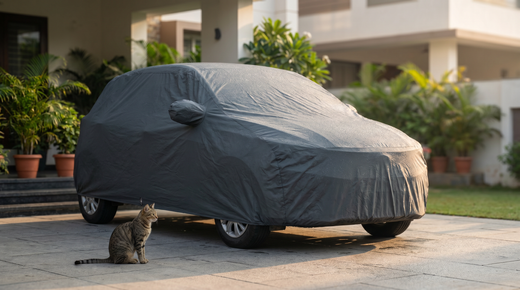
Will a Car Cover Stop Stray Dogs and Cats Scratching Your Car?
3 min read
3D vs 5D vs 7D vs ATM Car Floor Mats: What the Numbers Actually Mean
3 min read
Are 7D Floor Mats Worth It? An Honest Answer for Indian Cars
2 min read
Best Body Cover for the Mahindra Thar (3-Door) in India (2026)
2 min readLooking for a custom-fit cover for your car?
Get the perfect fit, premium protection and free shipping across India.